
The Windowless Corridor
Your Team May Not Need Another Wellness Program
A high-strain team can be well-paid, well-managed, and still be working inside an environment that drains them every day.
The signs are easy to misread:
People seem tired.
Focus drops.
Irritability rises.
Breaks do not seem to restore anyone.
The team leaves technical work but returns still tense, overstimulated, or mentally compressed.
Leadership may look for the cause in workload, culture, management, or benefits.
But sometimes the problem is more physical than that.
Sometimes the workplace gives people no way to exit strain.
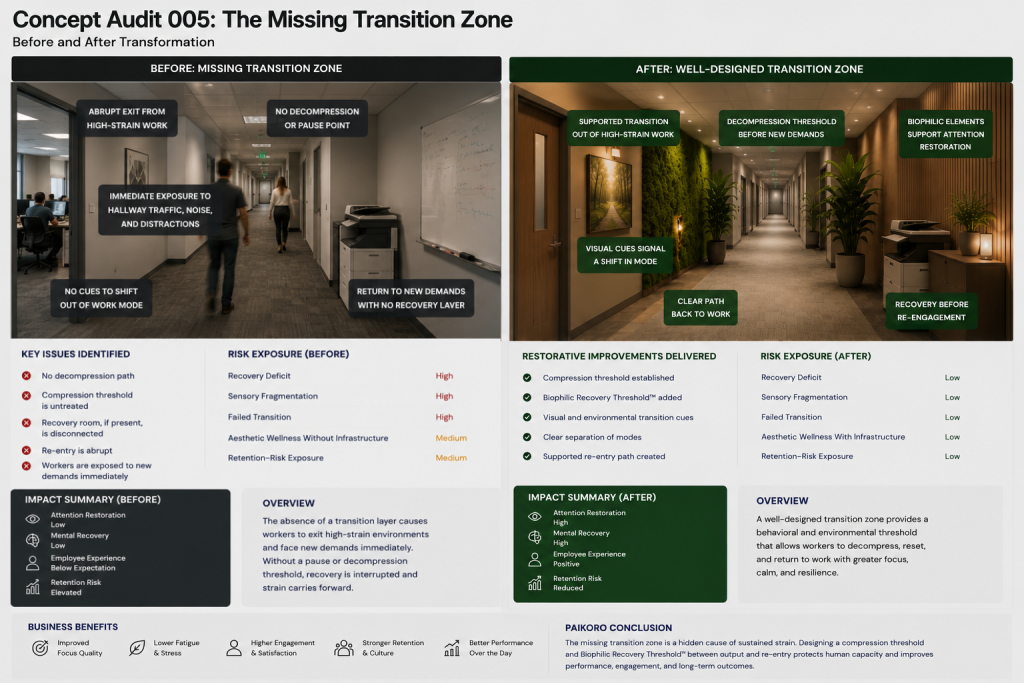
That is the problem Paikoro examines in The Missing Transition Zone.
The audit looks at a common condition: a high-cognition team exits a technical, sterile, machine-dominant, screen-heavy, or operationally precise zone directly into a hallway, open office, meeting area, or general circulation path. There is no environmental threshold that helps the body and attention system shift states.
A corridor like that may look harmless.
It may even look efficient.
But if it is the first space people enter after sustained cognitive demand, it is not neutral.
It either helps strain release, or it carries strain forward.
Paikoro reads this as a compression-threshold failure: the organization may be focused on the technical room or the break area, while missing the immediate exit path between strain and recovery.
The issue is not that the corridor needs decoration.
The issue is that the workplace may be missing recovery infrastructure at the exact point where recovery should begin.
No lighting shift.
No sensory cue.
No natural anchor.
No brief landing point.
No decompression layer.
The person leaves the room physically, but not cognitively.
For leaders, this matters because strain does not stay contained.
It can move through the day as fatigue, reduced attention, irritation, disengagement, slower recovery, and avoidable performance loss.
A break room down the hall may not solve that.
Recovery may need to begin at the threshold.
Paikoro’s principle is simple: Recovery begins at the threshold, not after the damage has already traveled through the building.
Tap to see the Concept Audit:
For organizations evaluating high-strain workplace environments, Paikoro offers the Environmental Systems Audit to identify where recovery infrastructure is missing and how the physical environment may be increasing cognitive strain.
Leave a Reply