
Standard Sterile Entry to Recovery Threshold: Designing a Med Spa Entry That Enhances Mood
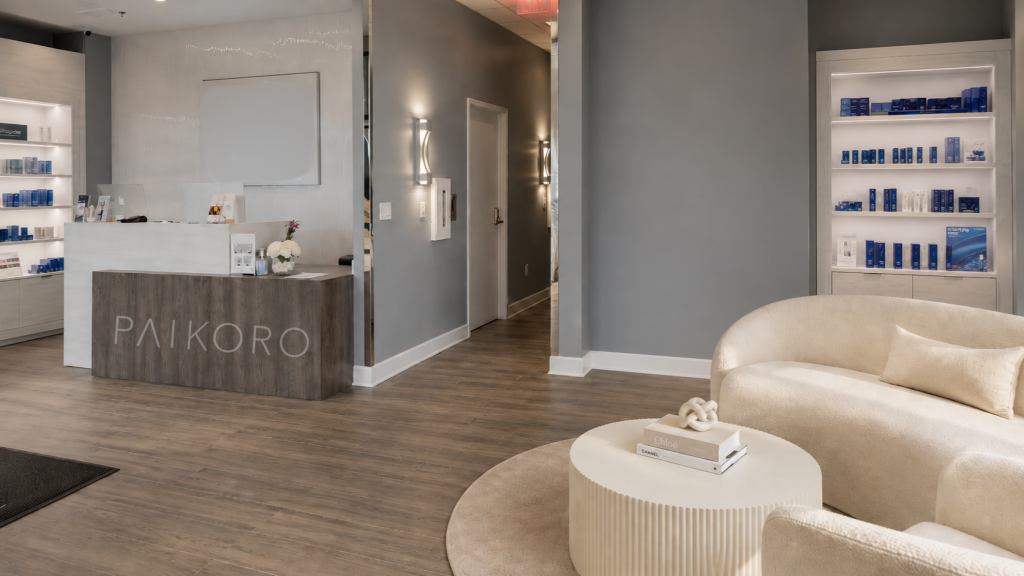
Thresholds are not neutral. They either preserve cognitive strain or start to release it.
In this project, Paikoro was asked to work with an already “nice” reception space—clean finishes, curated retail, soft seating—but the environment was still operating as a transaction zone. People checked in, waited, and left with their nervous systems largely unchanged. The before image captures that reality: visually orderly, functionally flat.
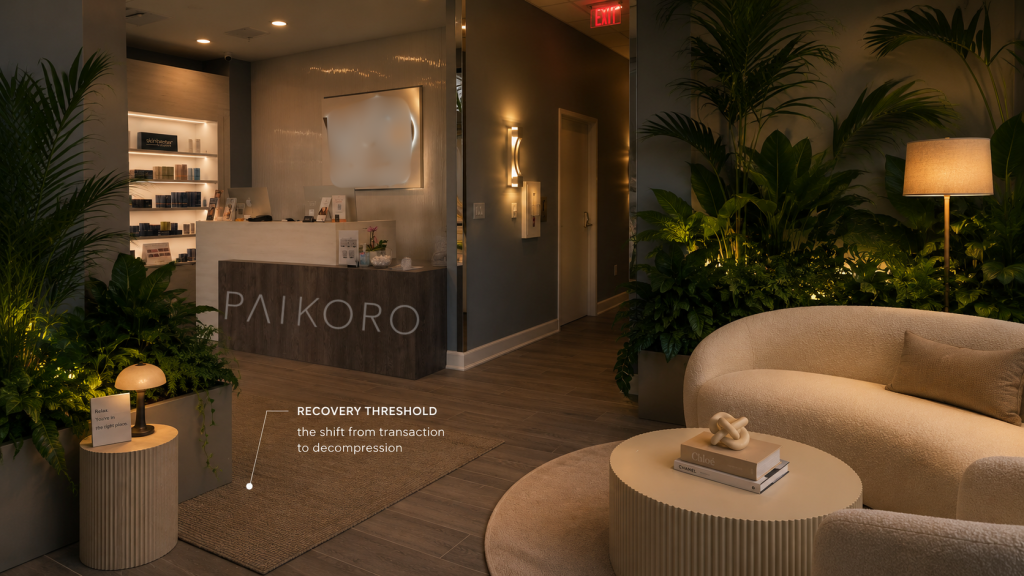
The after environment is what we call a recovery threshold. The spatial shell didn’t change. The infrastructure of experience did. We concentrated plant massing, recalibrated lighting, and reoriented focal points so that the first step into the space cues decompression instead of decision fatigue. The lobby stops behaving like a holding area and starts functioning as an active reset.
A few key moves:
- Density of nature, not decor
We treated plants as infrastructure, not styling. By concentrating greenery at the perimeter and eye level, the space gains visual depth and a sense of enclosure that quietly reduces vigilance. The result is less “room with plants,” more “softly sheltered clearing.” - Light as a nervous system tool
Overhead glare was dialed down and replaced with layered, warm, low-level lighting. That shift alone moves the space out of “retail brightness” and into a slower rhythm where people can transition out of task mode. Light becomes a regulator, not just illumination. - Furniture that signals rest, not waiting
The seating arrangement and material palette stay minimal, but their job changes. Curved forms, tactile fabrics, and the absence of visual clutter tell the body that nothing is demanded right now. You sit to recover, not to wait for the next instruction. - A clear story in a single glance
The most important outcome is legibility. When someone crosses this threshold, they understand—without language—that this is a place designed for their system to come down, even if only for a few minutes. That clarity is what turns “aesthetic upgrade” into human infrastructure.
This before-and-after is not about pretty versus prettier. It documents the shift from a space that passively hosts transactions to one that actively returns capacity to the people moving through it. That is the baseline for every environment Paikoro touches.
Leave a Reply