
From Converted Living Room to Recovery Threshold: Reprogramming a Med Spa Entry
The first three seconds inside a med spa determine whether the body prepares for care or braces for impact. This is especially true at the front door, where clients are still deciding if they trust you with their face, their body, and their data. The entry either functions as a recovery threshold or as leftover real estate dressed up with chairs and products.
This med spa’s entry was the latter. The services are advanced. The treatments are serious. But the moment you step through the door, the space insists on a different story.
What the space is really doing
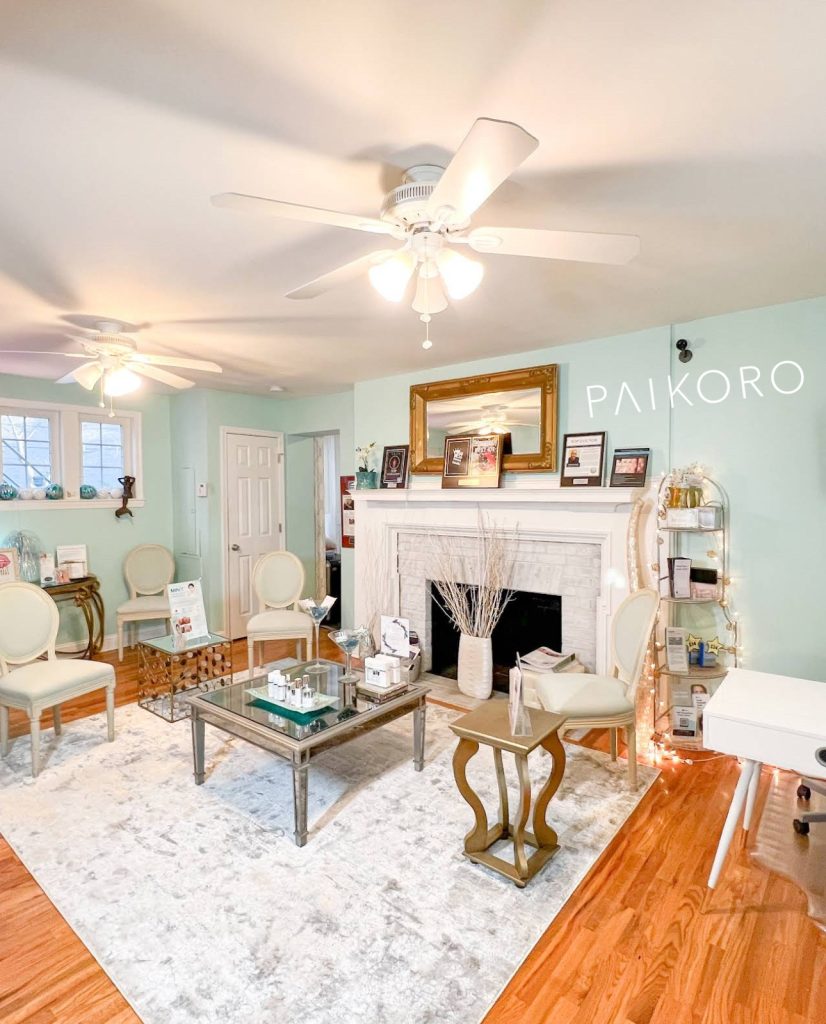
From a distance, the room looks “nice”: mint walls, a white fireplace, light wood floors, and plenty of seating. On closer inspection, the nervous system is working overtime.
• Ceiling fans with exposed bulbs create spinning, overhead glare more consistent with a rental apartment than a clinical environment.
• The fireplace mantel carries awards, framed documents, décor objects, and small plants—all competing for attention at once.
• Multiple chair styles ring the perimeter, facing in different directions, so clients are never sure where to sit or where to look.
• Retail products live on the coffee table, on small side tables, and on a wire or acrylic shelf wrapped in string lights. Nothing feels anchored.
• Paperwork and brochures are visible everywhere, sending a constant “there’s more to do” signal.
None of this was done in a “wrong” way. It is simply the default outcome of trying to make a converted living room feel welcoming without an underlying environmental strategy for the business inside. The result is an entry that looks friendly but behaves like cognitive clutter.
How Paikoro reads the room
Paikoro does not start with color palettes or throw pillows. We start with questions:
• What is the client’s state when they cross the threshold?
• Where is cognitive strain being added instead of reduced?
• What story does the space tell about competence, safety, and care before any human interaction occurs?
In this med spa entry, the message is mixed. The clinical tools and certifications say “professional,” while the visual language says “improvised.” The client’s body has to reconcile those two messages in real time. That reconciliation process is energy they can’t use for trust, consent, or recovery.
The transformation brief
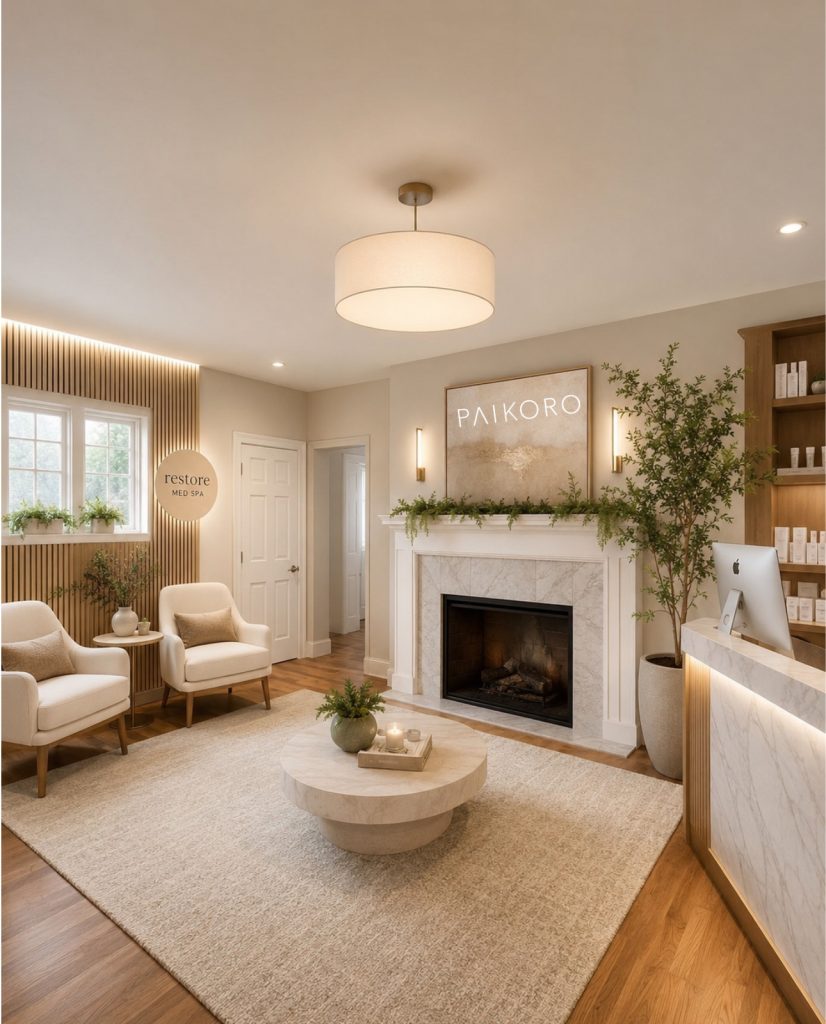
Our goal is not to make the room prettier. Our goal is to make it coherent and restorative. For this project, the transformation brief was simple and strict:
- Convert the entry into a recovery threshold rather than a holding area.
- Reduce visual and sensory noise so the nervous system can downshift on arrival.
- Align the physical environment with the level of clinical care being delivered.
Key moves we prescribe - Clarify the focal point
The first view from the front door must have a single job. We reassign the primary focal point to either a slim reception console or a calm fireplace wall with one large, minimal art piece or brand mark. Certificates and awards move to a secondary wall in a clean grid, not the main axis of attention. - Clean up the ceiling and the light
The ceiling is one of the loudest surfaces in the room. We remove visible ceiling fans and exposed bulbs in favor of a flush, architectural fixture and warm, indirect lighting. No fairy lights, no decorative string. Light becomes a tool for nervous-system regulation, not a party trick. - Create a coherent seating zone
Instead of lining the walls with multiple traditional chairs, we introduce a tighter arrangement of lounge seating: a small curved sofa or two to three upholstered chairs in a warm neutral palette. Seating is oriented toward a calm visual anchor, not the front door or a television. Clients know exactly where to land. - Treat plants as infrastructure, not props
Rather than scattering small plants around the room, we consolidate greenery into one defined biophilic moment: a low planter, a cluster of substantial broadleaf plants, or a simple vertical installation. The aim is to create a feeling of soft enclosure and depth, not decorative clutter. - Rationalize retail and information
Every product and every brochure adds cognitive load. We compress retail into a single, intentional display with clear organization and ample empty space. Brochures and forms live in closed storage, with only the essential items visible at check-in. The client’s first task should be to breathe, not to read. - What changes for the client
When these moves are implemented, the space begins to operate differently:
• Clients step into a warm, quiet visual field rather than a busy collage.
• The body understands where to go without verbal instructions.
• The environment communicates clinical competence and emotional safety in one message instead of two competing messages.
• The entry threshold becomes the first phase of treatment rather than an anteroom to it.
Why this matters for med spas
Med spas occupy a charged intersection: medicine, aesthetics, body image, and technology. Clients arrive with equal parts hope and apprehension. If the entry behaves like a converted living room, it asks them to override that apprehension on their own.
When you treat the threshold as human infrastructure, you take responsibility for that transition. You design an environment that returns attention, calm, and capacity before anyone touches a treatment device.
That is the work Paikoro does: reprogramming the everyday spaces of care so they stop leaking trust and start quietly repairing people the moment they walk through the door.
Leave a Reply